
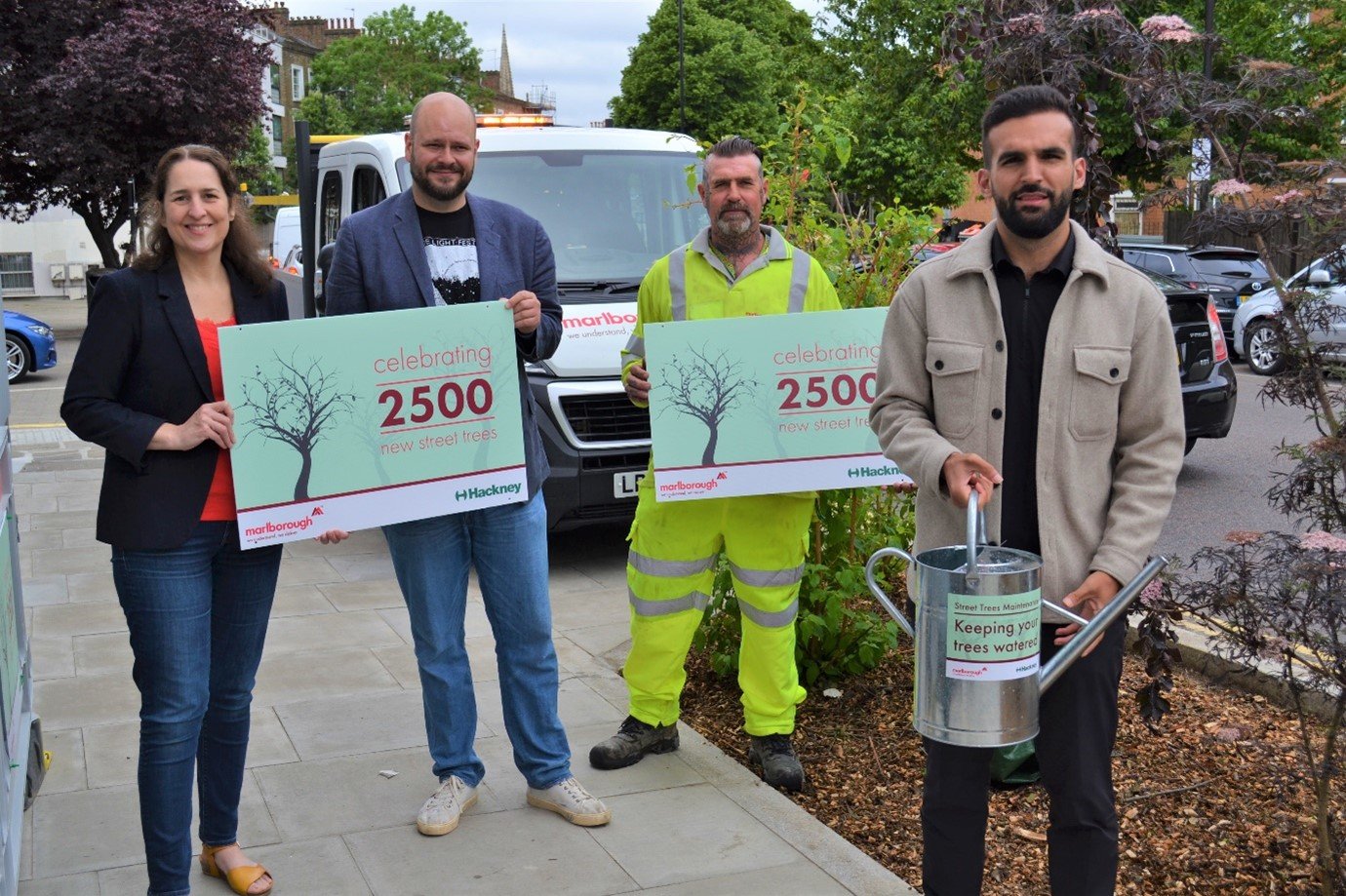
Hackney Council have committed to plant 5,000 by 2022. The 2,500th new street tree in the borough was planted in spring at the end of the planting season in Crossway in Dalston – as part of one of the largest urban tree planting programmes in the country.
Marlborough Highways and Hackney Council’s street tree team are working together to plant the 5,000 new street trees which are set to be planted in the borough by 2022, along with 1,000 new trees and 30,000 saplings in parks and green spaces, as part of the Council’s commitment to reach net zero emissions by 2040 and respond to the Climate Emergency.
Offering additional greenery, shade and benefits to mental health and wellbeing, the new street trees will see on-street canopy cover increase from 20% to 30% by 2022, playing an important role in filtering polluted air, sequestering carbon, providing more shade and reducing extreme temperatures in the summer and helping to mitigate local flooding.
The species planted are a mixture of native and non-native trees, ensuring that trees are appropriate for their setting, and resilient to pests and the changing climate. They include:
- Gleditsia triacanthos (Honey Locust Ruby Lace), Thornless variety with ruby coloured foliage that appears in spring and turns yellow through summer; drought and pollution tolerant
- Fagus sylvatica Black Swan (Weeping purple leaved Beech); Pollution tolerant and shade
- Ginkgo biloba (Ginkgo or Maidenhair tree) – the only living species in the order Ginkgoales. Fossils similar to this species have been found that date back to the middle Jurassic period approximately 170 million years ago – Unusual fan leaf shape which is green and turns bright yellow in the autumn
- Liquidambar styraciflua Slender Silhouette (Upright Sweetgum), columnar tree which has amazing colours of orange, yellow, red foliage in the autumn
- Sambucus nigra (Black Lace Elder), with lovely dark purple leaves and pink flowers which you can make a cordial from the flowers and berries very good for bees and insects
- Euonymus europaeus Red Cascade (Spindle Tree), which is nectar rich for bees has lots of rich autumn colours , small yellow flowers, bright pink and orange fruits Corylus avellana Contorta (Contorted Hazel), with branches that have an unusual twisted form like a corkscrew
- Corylus avellana our native Hazel which produces a nut for protein and can make a milk and Corylus avellana Zellernus (FIlbert which is Purple leaved ) and has a purple edible nut
- Cornus sanguinea Anny’s Winter Orange (Orange Dogwood) – orange-red coloured stems look particularly striking in winter.
The mix of species also means an increase in local biodiversity and that the trees are colourful throughout the year.
For all the latest news, follow us on LinkedIn, Facebook, Twitter and Instagram.
Find out more about Our Work.
Photo: From left to right: Cllr Caroline Woodley, Mayor of Hackney, Philip Glanville, Dean Billson, Marlborough Highways, Cllr Mete Coban.