
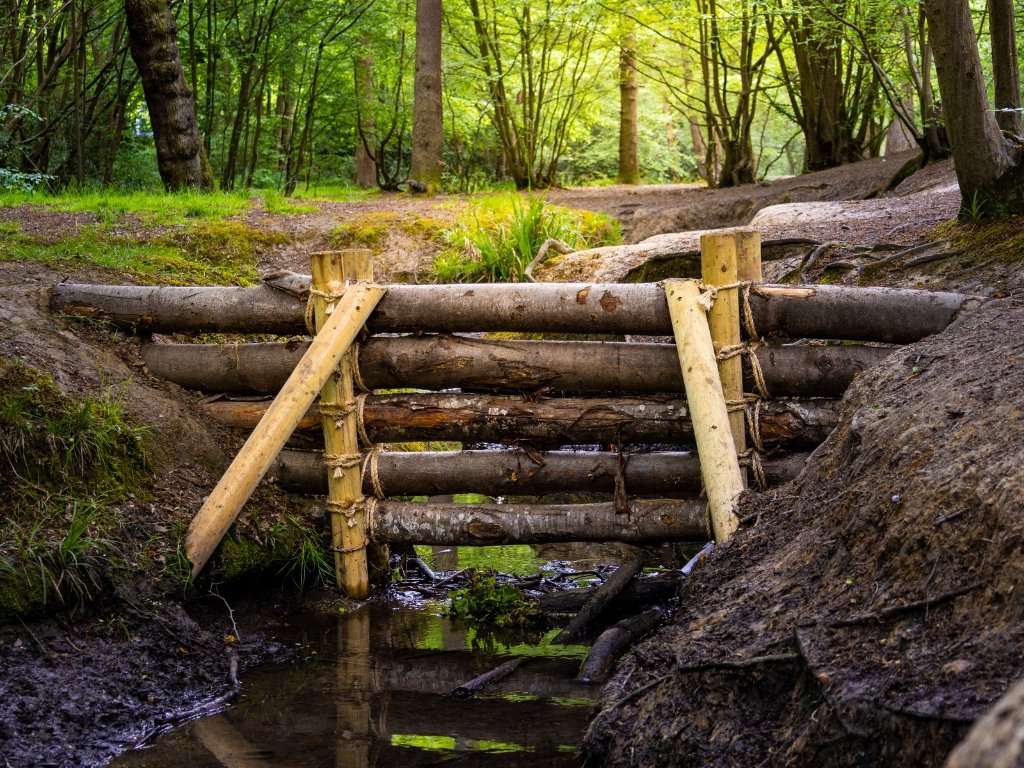
Marlborough Highways has delivered a series of natural flood management interventions within Belfairs Woods and Hadleigh Great Wood in Southend-on-Sea, in partnership with Southend-on-Sea City Council.
The works form part of the wider Catchment to Coast programme and involved the installation of six leaky dams along a 500m stretch of the Prittle Brook. In collaboration with the Council, Essex Wildlife Trust and the Environment Agency, Marlborough delivered the scheme within a sensitive woodland environment, helping to slow the flow of water during periods of heavy rainfall.
The six leaky dams include five timber structures and one trial mycelium dam. The timber dams were built using coppiced sweet chestnut sourced directly from Belfairs Woods, reducing the need for imported materials and helping to limit disruption on site.
Each timber structure was formed using logs fixed between driven timber posts. The dams are designed to allow normal water flow at low levels, while holding back higher flows during heavy rainfall. This helps to reduce pressure on downstream drainage networks and supports a more natural approach to flood management.
A trial mycelium dam was also installed using hessian sacks filled with mycelium, a natural fungal material. The trial will help explore how mycelium performs within natural flood management, including its potential role in supporting water quality and interacting with water flow.
Delivering the works within a Site of Special Scientific Interest required careful planning, ecological protection and regulatory approvals. Construction was limited to a winter programme to avoid the bird breeding season, with completion required before early March 2026.
Access constraints, ongoing public use of the woodland, and a gas main running through the site also required close coordination throughout the programme. Materials were cut and moved along existing woodland paths, with small plant and hand tools used to install the dams safely and sensitively.
The scheme has introduced a series of upstream interventions that will help slow the flow of water through the woodland during heavy rainfall, while allowing normal water movement to continue.
By using natural materials sourced from the woodland itself, the works were delivered with minimal disruption to the surrounding environment. Ongoing monitoring will now help inform future phases of the Catchment to Coast programme.
Jane Brockman, Civil Engineer at Southend-on-Sea City Council, said:
“This installation represented a first for us in Southend and provided a valuable learning experience for all those involved. Marlborough’s flexibility and proactive support in delivering this work were instrumental in helping us achieve a key project objective.
As we continue to monitor the performance and effectiveness of these leaky dams over time, we will gain further insight into their benefits. It is anticipated that the success of this initiative will open up further opportunities to implement similar nature-based solutions, supporting sustainable flood management.”